The navigation property in docs.json controls the structure and information hierarchy of your documentation. With proper navigation configuration, you can organize your content so that users can find exactly what they’re looking for. Choose one primary organizational pattern at the root level of your navigation. Once you’ve chosen your primary pattern, you can nest other navigation elements within it.

Pages

Pages are the most fundamental navigation component. Each page is an MDX file in your documentation repository. Decorative graphic of pages. In the navigation object, pages is an array where each entry must reference the path to a page file.


{
  "navigation": {
    "pages": [
      "settings",
      "pages",
      "navigation",
      "themes",
      "custom-domain"
    ]
  }
}

Groups

Use groups to organize your sidebar navigation into sections. Groups can be nested within each other, labeled with tags, and styled with icons. Decorative graphic of groups. In the navigation object, groups is an array where each entry is an object that requires a group field and a pages field. The icon, tag, and expanded fields are optional.


{
  "navigation": {
    "groups": [
      {
        "group": "Getting started",
        "icon": "play",
        "pages": [
          "quickstart",
          {
            "group": "Editing",
            "expanded": false,
            "icon": "pencil",
            "pages": [
              "installation",
              "editor"
            ]
          }
        ]
      },
      {
        "group": "Writing content",
        "icon": "notebook-text",
        "tag": "NEW",
        "pages": [
          "writing-content/page",
          "writing-content/text"
        ]
      }
    ]
  }
}

Default expanded state

Use the expanded property to control the default state of a nested group in the navigation sidebar.
  • expanded: true: Group is expanded by default.
  • expanded: false or omitted: Group is collapsed by default.
The expanded property only affects nested groups—groups within groups. Top-level groups are always expanded and cannot be collapsed.
{
  "group": "Getting started",
  "pages": [
    "quickstart",
    {
      "group": "Advanced",
      "expanded": false,
      "pages": ["installation", "configuration"]
    }
  ]
}

Tabs

Tabs create distinct sections of your documentation with separate URL paths. Tabs create a horizontal navigation bar at the top of your documentation that lets users switch between sections. Decorative graphic of a tab navigation. In the navigation object, tabs is an array where each entry is an object that requires a tab field and can contain other navigation fields such as groups, pages, icons, or links to external pages.


{
  "navigation": {
    "tabs": [
      {
        "tab": "API reference",
        "icon": "square-terminal",
        "pages": [
          "api-reference/get",
          "api-reference/post",
          "api-reference/delete"
        ]
      },
      {
        "tab": "SDKs",
        "icon": "code",
        "pages": [
          "sdk/fetch",
          "sdk/create",
          "sdk/delete"
        ]
      },
      {
        "tab": "Blog",
        "icon": "newspaper",
        "href": "https://external-link.com/blog"
      }
    ]
  }
}
Menus add dropdown navigation items to a tab. Use menus to help users go directly to specific pages within a tab. In the navigation object, menu is an array where each entry is an object that requires an item field and can contain other navigation fields such as groups, pages, icons, or links to external pages. Menu items can only contain groups, pages, and external links.
{
  "navigation": {
    "tabs": [
      {
        "tab": "Developer tools",
        "icon": "square-terminal",
        "menu": [
          {
            "item": "API reference",
            "icon": "rocket",
            "groups": [
              {
                "group": "Core endpoints",
                "icon": "square-terminal",
                "pages": [
                  "api-reference/get",
                  "api-reference/post",
                  "api-reference/delete"
                ]
              }
            ]
          },
          {
            "item": "SDKs",
            "icon": "code",
            "description": "SDKs are used to interact with the API.",
            "pages": [
              "sdk/fetch",
              "sdk/create",
              "sdk/delete"
            ]
          }
        ]
      }
    ]
  }
}

Anchors

Anchors add persistent navigation items to the top of your sidebar. Use anchors to section your content, provide quick access to external resources, or create prominent calls to action. Decorative graphic of an anchor navigation. In the navigation object, anchors is an array where each entry is an object that requires an anchor field and can contain other navigation fields such as groups, pages, icons, or links to external pages.


{
  "navigation": {
    "anchors": [
      {
        "anchor": "Documentation",
        "icon": "book-open",
        "pages": [
          "quickstart",
          "development",
          "navigation"
        ]
      },
      {
        "anchor": "API reference",
        "icon": "square-terminal",
        "pages": [
          "api-reference/get",
          "api-reference/post",
          "api-reference/delete"
        ]
      },
      {
        "anchor": "Blog",
        "href": "https://external-link.com/blog"
      }
    ]
  }
}

Global anchors

Use global anchors for external links that should appear on all pages, regardless of which section of your navigation the user is viewing. Global anchors are particularly useful for linking to resources outside your documentation, such as a blog, community forum, or support portal.
Global anchors must include an href field pointing to an external URL. They cannot contain relative paths.
{
  "navigation": {
    "global":  {
      "anchors": [
        {
          "anchor": "Community",
          "icon": "house",
          "href": "https://slack.com"
        },
        {
          "anchor": "Blog",
          "icon": "pencil",
          "href": "https://mintlify.com/blog"
        }
      ]
    },
    "tabs": /*...*/
  }
}
Dropdowns are contained in an expandable menu at the top of your sidebar navigation. Each item in a dropdown directs to a section of your documentation. Decorative graphic of a dropdown navigation. In the navigation object, dropdowns is an array where each entry is an object that requires a dropdown field and can contain other navigation fields such as groups, pages, icons, or links to external pages.


{
  "navigation": {
    "dropdowns": [
      {
        "dropdown": "Documentation",
        "icon": "book-open",
        "pages": [
          "quickstart",
          "development",
          "navigation"
        ]
      },
      {
        "dropdown": "API reference",
        "icon": "square-terminal",
        "pages": [
          "api-reference/get",
          "api-reference/post",
          "api-reference/delete"
        ]
      },
      {
        "dropdown": "Blog",
        "href": "https://external-link.com/blog"
      }
    ]
  }
}

Products

Decorative graphic of a product switcher. Products create a dedicated navigation division for organizing product-specific documentation. Use products to separate different offerings, services, or major feature sets within your documentation. In the navigation object, products is an array where each entry is an object that requires a product field and can contain other navigation fields such as groups, pages, icons, or links to external pages.
{
  "navigation": {
    "products": [
      {
        "product": "Core API",
        "description": "Core API description",    
        "icon": "api",
        "groups": [
          {
            "group": "Getting started",
            "pages": [
              "core-api/quickstart",
              "core-api/authentication"
            ]
          },
          {
            "group": "Endpoints",
            "pages": [
              "core-api/users",
              "core-api/orders"
            ]
          }
        ]
      },
      {
        "product": "Analytics Platform",
        "description": "Analytics Platform description",
        "icon": "chart-bar",
        "pages": [
          "analytics/overview",
          "analytics/dashboard",
          "analytics/reports"
        ]
      },
      {
        "product": "Mobile SDK",
        "description": "Mobile SDK description",
        "icon": "smartphone",
        "href": "https://mobile-sdk-docs.example.com"
      }
    ]
  }
}

OpenAPI

Integrate OpenAPI specifications directly into your navigation structure to automatically generate API documentation. Create dedicated API sections or place endpoint pages within other navigation components. Set a default OpenAPI specification at any level of your navigation hierarchy. Child elements will inherit this specification unless they define their own specification.
When you add the openapi property to a navigation element (such as an anchor, tab, or group) without specifying any pages, Mintlify automatically generates pages for all endpoints defined in your OpenAPI specification.To control which endpoints appear, explicitly list the desired endpoints in a pages array.
For more information about referencing OpenAPI endpoints in your docs, see the OpenAPI setup.
{
  "navigation": {
    "groups": [
      {
        "group": "API reference",
        "openapi": "/path/to/openapi-v1.json",
        "pages": [
          "overview",
          "authentication",
          "GET /users",
          "POST /users",
          {
            "group": "Products",
            "openapi": "/path/to/openapi-v2.json",
            "pages": [
              "GET /products",
              "POST /products"
            ]
          }
        ]
      }
    ]
  }
}

Versions

Partition your navigation into different versions. Versions are selectable from a dropdown menu. Decorative graphic of a version switcher. In the navigation object, versions is an array where each entry is an object that requires a version field and can contain any other navigation fields.


{
  "navigation": {
    "versions": [
      {
        "version": "1.0.0",
        "groups": [
          {
            "group": "Getting started",
            "pages": ["v1/overview", "v1/quickstart", "v1/development"]
          }
        ]
      },
      {
        "version": "2.0.0",
        "groups": [
          {
            "group": "Getting started",
            "pages": ["v2/overview", "v2/quickstart", "v2/development"]
          }
        ]
      }
    ]
  }
}

Languages

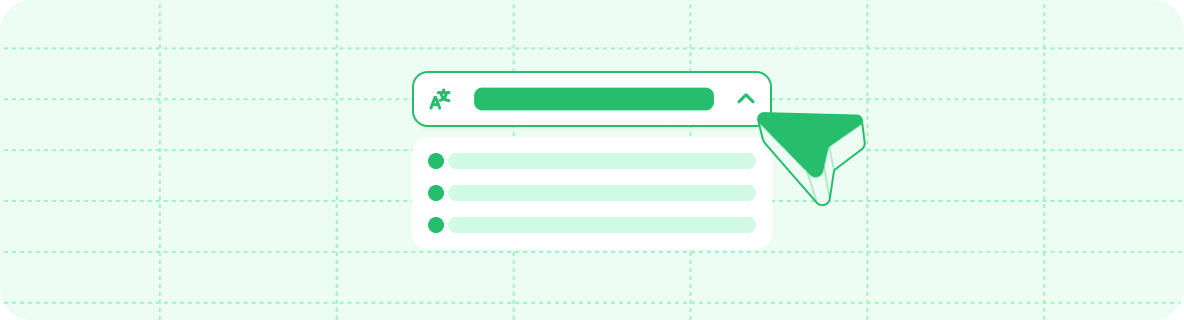
Partition your navigation into different languages. Languages are selectable from a dropdown menu. Decorative graphic of a language switcher. In the navigation object, languages is an array where each entry is an object that requires a language field and can contain any other navigation fields. We currently support the following languages for localization:
https://mintcdn.com/mintlify-slack-bot/o6JxnzJoevMfZys5/images/navigation/languages/ar.png?fit=max&auto=format&n=o6JxnzJoevMfZys5&q=85&s=21dc66572dbfe2dd8ebc00bb9b3b611d

Arabic (ar)

https://mintcdn.com/mintlify-slack-bot/o6JxnzJoevMfZys5/images/navigation/languages/cs.png?fit=max&auto=format&n=o6JxnzJoevMfZys5&q=85&s=6da30544aabc626e1a35d759f513822a

Czech (cs)

https://mintcdn.com/mintlify-slack-bot/o6JxnzJoevMfZys5/images/navigation/languages/cn.png?fit=max&auto=format&n=o6JxnzJoevMfZys5&q=85&s=cab9b4e668545aeae06da37a3ff5017d

Chinese (cn)

https://mintcdn.com/mintlify-slack-bot/o6JxnzJoevMfZys5/images/navigation/languages/cn.png?fit=max&auto=format&n=o6JxnzJoevMfZys5&q=85&s=cab9b4e668545aeae06da37a3ff5017d

Chinese (zh-Hant)

https://mintcdn.com/mintlify-slack-bot/o6JxnzJoevMfZys5/images/navigation/languages/nl.png?fit=max&auto=format&n=o6JxnzJoevMfZys5&q=85&s=29bb339aea34b18a8c1dbb44436fef74

Dutch (nl)

https://mintcdn.com/mintlify-slack-bot/o6JxnzJoevMfZys5/images/navigation/languages/en.png?fit=max&auto=format&n=o6JxnzJoevMfZys5&q=85&s=8d32cda424658f52f389299c1e41d2c6

English (en)

https://mintcdn.com/mintlify-slack-bot/o6JxnzJoevMfZys5/images/navigation/languages/fr.png?fit=max&auto=format&n=o6JxnzJoevMfZys5&q=85&s=5a819c9ab6245bdb357546f8c7337229

French (fr)

https://mintcdn.com/mintlify-slack-bot/o6JxnzJoevMfZys5/images/navigation/languages/de.png?fit=max&auto=format&n=o6JxnzJoevMfZys5&q=85&s=b757e2f52a7c2d0f283312038774e126

German (de)

https://mintcdn.com/mintlify-slack-bot/o6JxnzJoevMfZys5/images/navigation/languages/hi.png?fit=max&auto=format&n=o6JxnzJoevMfZys5&q=85&s=4875f127d705d26dc4774577d7767741

Hindi (hi)

https://mintcdn.com/mintlify-slack-bot/o6JxnzJoevMfZys5/images/navigation/languages/id.png?fit=max&auto=format&n=o6JxnzJoevMfZys5&q=85&s=fe5d01267e4210523106fce2e5cd8e73

Indonesian (id)

https://mintcdn.com/mintlify-slack-bot/o6JxnzJoevMfZys5/images/navigation/languages/it.png?fit=max&auto=format&n=o6JxnzJoevMfZys5&q=85&s=d01cb1048ad72e90dfa071311b6c6b55

Italian (it)

https://mintcdn.com/mintlify-slack-bot/o6JxnzJoevMfZys5/images/navigation/languages/jp.png?fit=max&auto=format&n=o6JxnzJoevMfZys5&q=85&s=ea23b29e2934016edcd8cf98f345de2a

Japanese (jp)

https://mintcdn.com/mintlify-slack-bot/o6JxnzJoevMfZys5/images/navigation/languages/ko.png?fit=max&auto=format&n=o6JxnzJoevMfZys5&q=85&s=44fc01746729a66acbfcc5cd1a6ddcf0

Korean (ko)

https://mintcdn.com/mintlify-slack-bot/o6JxnzJoevMfZys5/images/navigation/languages/lv.png?fit=max&auto=format&n=o6JxnzJoevMfZys5&q=85&s=e0aa93ded8675e321b703d3de072e6a7

Latvian (lv)

https://mintcdn.com/mintlify-slack-bot/o6JxnzJoevMfZys5/images/navigation/languages/no.png?fit=max&auto=format&n=o6JxnzJoevMfZys5&q=85&s=81599672b9411e6e33e45caf680fa3c4

Norwegian (no)

https://mintcdn.com/mintlify-slack-bot/o6JxnzJoevMfZys5/images/navigation/languages/pt-br.png?fit=max&auto=format&n=o6JxnzJoevMfZys5&q=85&s=a76a6641842b9fe1797be2faee48f445

Portuguese (pt-BR)

https://mintcdn.com/mintlify-slack-bot/o6JxnzJoevMfZys5/images/navigation/languages/ro.png?fit=max&auto=format&n=o6JxnzJoevMfZys5&q=85&s=3aa90ff96d42bf979c62db3d30f6d9e1

Romanian (ro)

https://mintcdn.com/mintlify-slack-bot/o6JxnzJoevMfZys5/images/navigation/languages/ru.png?fit=max&auto=format&n=o6JxnzJoevMfZys5&q=85&s=7df09c92eb924e028f955efa31a6a83e

Russian (ru)

https://mintcdn.com/mintlify-slack-bot/o6JxnzJoevMfZys5/images/navigation/languages/es.png?fit=max&auto=format&n=o6JxnzJoevMfZys5&q=85&s=de4659dc154c94a7fda472cb114e4ecb

Spanish (es)

https://mintcdn.com/mintlify-slack-bot/o6JxnzJoevMfZys5/images/navigation/languages/sv.png?fit=max&auto=format&n=o6JxnzJoevMfZys5&q=85&s=c4ba9f6f095df67967938a36ee304334

Swedish (sv)

https://mintcdn.com/mintlify-slack-bot/o6JxnzJoevMfZys5/images/navigation/languages/tr.png?fit=max&auto=format&n=o6JxnzJoevMfZys5&q=85&s=34ce6a4de55e7ec995e1c0dec8dfd215

Turkish (tr)

https://mintcdn.com/mintlify-slack-bot/o6JxnzJoevMfZys5/images/navigation/languages/ua.png?fit=max&auto=format&n=o6JxnzJoevMfZys5&q=85&s=71fb3944baaf2d9dddefbcd1226f4b26

Ukrainian (ua)

https://mintcdn.com/mintlify-slack-bot/o6JxnzJoevMfZys5/images/navigation/languages/vi.png?fit=max&auto=format&n=o6JxnzJoevMfZys5&q=85&s=f0263ddc3f6df2884daf9f6040188ce2

Vietnamese (vi)

{
  "navigation": {
    "languages": [
      {
        "language": "en",
        "groups": [
          {
            "group": "Getting started",
            "pages": ["en/overview", "en/quickstart", "en/development"]
          }
        ]
      },
      {
        "language": "es",
        "groups": [
          {
            "group": "Getting started",
            "pages": ["es/overview", "es/quickstart", "es/development"]
          }
        ]
      }
    ]
  }
}
For automated translations, contact our sales team to discuss solutions.

Nesting

Navigation elements can be nested within each other to create complex hierarchies. You must have one root-level parent navigation element such as tabs, groups, or a dropdown. You can nest other types of navigation elements within your primary navigation pattern. Each navigation element can contain one type of child element at each level of your navigation hierarchy. For example, a tab can contain anchors that contain groups, but a tab cannot contain both anchors and groups at the same level.
{
  "navigation": {
    "tabs": [
      {
        "tab": "Documentation",
        "anchors": [
          {
            "anchor": "Guides",
            "icon": "book-open",
            "pages": ["quickstart", "tutorial"]
          },
          {
            "anchor": "API Reference",
            "icon": "code",
            "pages": ["api/overview", "api/endpoints"]
          }
        ]
      },
      {
        "tab": "Resources",
        "groups": [
          {
            "group": "Help",
            "pages": ["support", "faq"]
          }
        ]
      }
    ]
  }
}
Breadcrumbs display the full navigation path at the top of pages. Some themes have breadcrumbs enabled by default and others do not. You can control whether breadcrumbs are enabled for your site using the styling property in your docs.json.
"styling": {
  "eyebrows": "breadcrumbs"
}

Interaction configuration

Control how users interact with navigation elements using the interaction property in your docs.json.

Enable auto-navigation for groups

When a user expands a navigation group, some themes will automatically navigate to the first page in the group. You can override a theme’s default behavior using the drilldown option.
  • Set to true to force automatic navigation to the first page when a navigation group is selected.
  • Set to false to prevent navigation and only expand or collapse the group when it is selected.
  • Leave unset to use the theme’s default behavior.
"interaction": {
  "drilldown": true  // Force navigation to first page when a user expands a dropdown
}